Category: Website Strategy

  • Why Chatbots Are Becoming the New Front Door to Your Business

    Why Chatbots Are Becoming the New Front Door to Your Business

    Have you ever visited a website with a quick question, only to find yourself digging through pages of information looking for an answer?

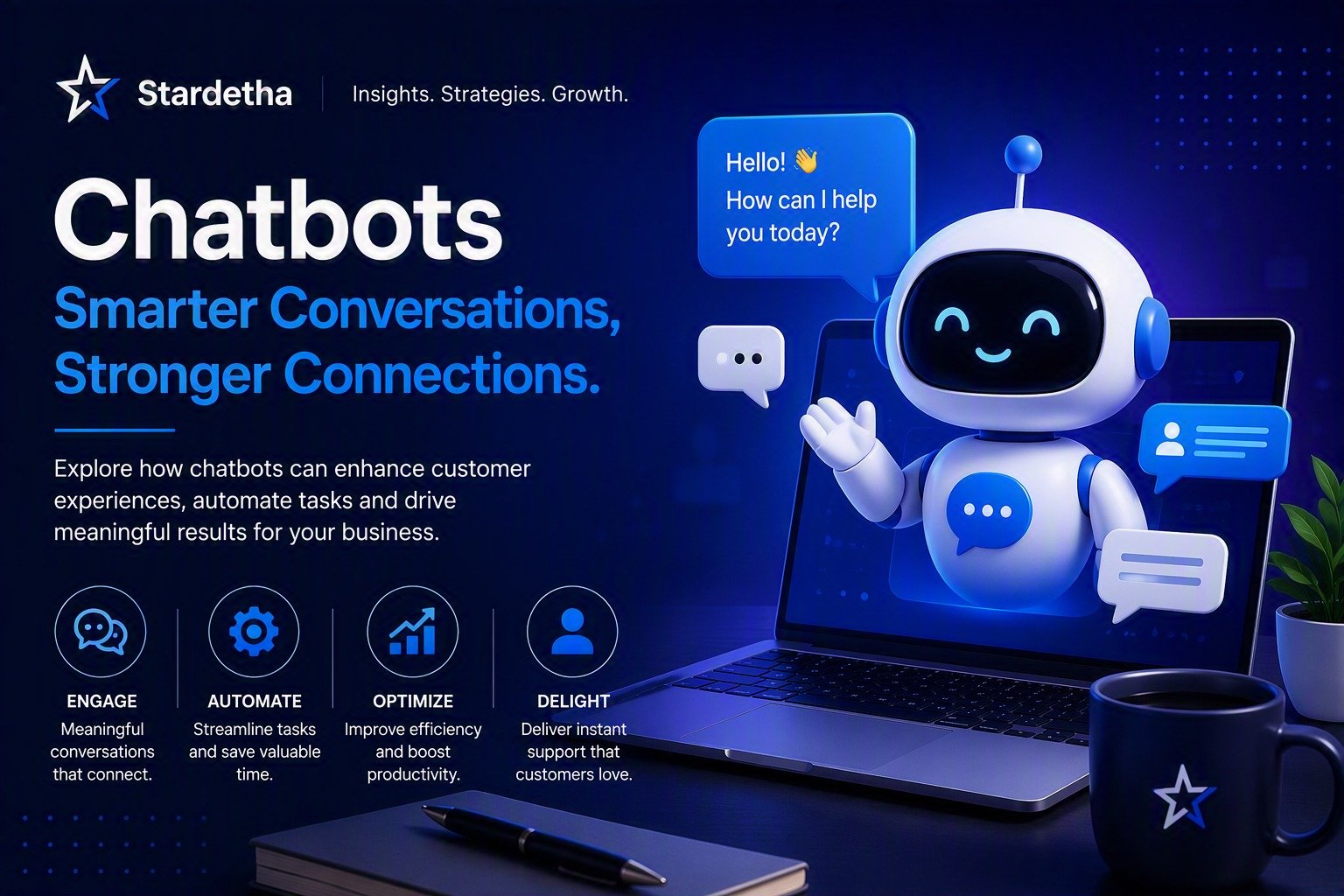
    Now imagine a friendly assistant popping up and saying, “Hi! How can I help you today?” That’s exactly what a chatbot does. Chatbots have become one of the most powerful tools for businesses looking to provide instant support, engage visitors, and improve customer experiences. Whether you’re shopping online, booking a service, or looking for information, chances are you’ve interacted with a chatbot without even realizing it. But what exactly are chatbots, and why are they becoming so important?

    What Is a Chatbot?

    A chatbot is a digital assistant designed to communicate with users through text or voice conversations. Think of it as a virtual team member that is always available, never takes a lunch break, and can assist thousands of people at the same time. Chatbots can answer questions, recommend products, schedule appointments, process requests, and even help customers complete purchases.

    The best part? They work 24/7.

    Why Businesses Are Falling in Love with Chatbots

    Customer expectations have changed dramatically. People want answers now, not tomorrow. When someone visits your website, they don’t want to wait hours for an email response or spend minutes searching for information. A chatbot can provide immediate assistance, helping visitors find exactly what they need within seconds.

    Here are a few reasons businesses are embracing chatbot technology:

    Instant Customer Support

    Imagine having a support representative available every second of every day. Chatbots make this possible by answering common questions instantly. Whether it’s checking business hours, finding pricing information, or tracking an order, chatbots provide quick and convenient support.

    More Leads and Sales

    Many website visitors leave because they can’t quickly find what they’re looking for. A chatbot can engage visitors the moment they arrive, answer their questions, and guide them toward making a purchase or submitting an inquiry.

    This can turn casual visitors into loyal customers.

    Reduced Workload for Staff

    Let’s be honest: customer service teams spend a lot of time answering the same questions repeatedly. Chatbots can handle routine inquiries automatically, allowing employees to focus on more complex and valuable tasks.

    Better User Experience

    People appreciate convenience. When visitors receive immediate assistance, they are more likely to stay on your website and have a positive experience with your brand.

    Different Types of Chatbots

    Not all chatbots work the same way.

    Rule-Based Chatbots

    These chatbots follow predefined rules and scripts. For example, if a user asks about delivery times, the chatbot provides a specific response from its database.

    They’re simple, reliable, and effective for handling frequently asked questions.

    AI-Powered Chatbots

    AI-powered chatbots are much smarter. Using artificial intelligence and natural language processing, they can understand user intent, interpret different ways of asking questions, and generate more natural responses.

    These chatbots can hold conversations that feel surprisingly human.

    Hybrid Chatbots

    Hybrid chatbots combine the best of both worlds. They use predefined rules for straightforward tasks while relying on AI to handle more complex conversations. Many modern businesses prefer this approach because it balances accuracy with flexibility.

    How AI Is Taking Chatbots to the Next Level

    The rise of artificial intelligence has transformed what chatbots can do.

    Today’s AI chatbots can:

    • Understand natural language

    • Answer complex questions

    • Translate multiple languages

    • Provide personalized recommendations

    • Generate content

    • Assist with research

    • Learn from previous interactions

    Instead of simply matching keywords, AI chatbots can understand the meaning behind a question and respond accordingly. That’s a huge leap from the basic chatbots of just a few years ago.

    Real-World Examples of Chatbots

    Chatbots are everywhere.

    You can find them helping customers in:

    • E-commerce stores

    • Universities and educational institutions

    • Banks and financial services

    • Healthcare organizations

    • Government services

    • Travel and tourism websites

    • Technology support centers

    Whether you are asking about a flight, checking your bank balance, or finding information about a university course, a chatbot is often working behind the scenes.

    Are Chatbots Perfect?

    Not quite.

    While chatbots are incredibly useful, they still have limitations. They may struggle with highly specialized questions, misunderstand unclear requests, or require human intervention for complex issues. That’s why the most effective chatbot solutions combine automation with access to real people when needed.

    A chatbot shouldn’t replace human interaction entirely. Instead, it should enhance it.

    The Future of Chatbots

    We’re only scratching the surface of what chatbots can do. As artificial intelligence continues to advance, future chatbots are expected to become even more conversational, personalized, and intelligent.

    We can expect chatbots to:

    • Understand context more accurately

    • Support more languages

    • Offer voice-based conversations

    • Integrate deeply with business systems

    • Deliver highly personalized experiences

    For businesses, this means better customer engagement and more efficient operations. For customers, it means faster, smarter, and more helpful digital experiences.

    Final Thoughts

    Chatbots are no longer just a trendy technology. They have become an essential tool for modern businesses looking to improve customer service, generate leads, and create better user experiences. Whether you’re running a small business, an e-commerce store, a university website, or a large enterprise, a chatbot can help you connect with visitors in a faster and more meaningful way.

    In a world where people expect instant answers, chatbots are helping businesses stay responsive, competitive, and available around the clock.

    Stardetha can help with technology setup, website planning and supplier coordination. Contact us if your current ownership or account structure is unclear.


  • Website Hosting, Domains and Business Email Explained

    Website Hosting, Domains and Business Email Explained

    A domain, website hosting and business email often arrive in one package, but they are separate services. Understanding the difference makes renewals, troubleshooting and supplier changes much safer.

    The domain is the address

    Your domain is the human-readable name people type, such as example.co.za. It is registered for a period and must be renewed. The registrant details and registrar account should belong to the business, with current recovery information and multi-factor authentication where available.

    DNS is the directory

    Domain Name System records direct web visitors and email to the correct services. Changing these records carelessly can take the website or email offline. Keep a record of existing DNS settings before a migration, and coordinate changes with everyone who operates connected systems.

    Hosting is the website’s operating environment

    Hosting stores and serves the website files and database. Compare providers on reliability, support, backups, security, resource limits, server location requirements and compatibility—not storage numbers alone. A busy ecommerce site needs a different environment from a small brochure site.

    Business email is its own service

    An address such as name@yourcompany.co.za uses the domain but relies on an email provider and correctly configured DNS records. Email history normally does not move automatically when the website moves. Plan mailbox creation, migration, security and backups separately.

    WordPress is the website platform

    WordPress runs inside the hosting environment. Themes shape presentation, plugins add functionality and the database stores content and settings. Keeping the domain does not automatically preserve the website; keeping a website backup does not automatically preserve email.

    Protect ownership and continuity

    • Register critical accounts in the company’s name.
    • Use role-based access instead of sharing one password.
    • Record suppliers, renewal dates and responsible staff.
    • Store recovery codes securely.
    • Confirm that independent backups can be restored elsewhere.

    When requesting a quotation, ask for each service and renewal to be itemised. Stardetha can help with technology setup, website planning and supplier coordination. Contact us if your current ownership or account structure is unclear.

  • What Happens During a Website Consultation with Stardetha?

    What Happens During a Website Consultation with Stardetha?

    A website consultation is a working conversation about the business, its customers and the role the website should play. It helps us avoid recommending features simply because they are fashionable and gives you a clearer basis for deciding what to build.

    Before the meeting

    Share the current website, if one exists, plus a short description of the business and the main challenge. Helpful material can include a company profile, service list, brand assets, competitor examples, analytics access and questions from your team. Do not delay the conversation because everything is not yet organised—we can identify what is missing together.

    We begin with the business goal

    We will ask what a successful website should change. That might be increasing suitable enquiries, explaining a complex service, presenting a catalogue, selling online or reducing repeated support questions. We also discuss the value and urgency of those outcomes.

    Then we look at the customer

    Who needs the service? What do they already know? What concerns might prevent them from contacting you? What proof would help them trust the company? These questions shape the navigation, page content and calls to action.

    We review practical constraints

    • Existing domain, hosting, email and website access.
    • Brand identity, photographs and content readiness.
    • Required integrations, forms, payments or catalogue tools.
    • Internal approval process and who will maintain the site.
    • Target timing and a realistic budget range.
    • Security, privacy or operational requirements.

    What you can expect afterwards

    The next step depends on the engagement, but it may include a recommended scope, priorities, assumptions, exclusions and quotation. Larger projects may need a paid discovery phase before a final build estimate. Any payment link for consultation-related work is provided after we confirm the appropriate service with you.

    How to get the most value from the session

    Bring decision-makers where possible, be candid about previous problems and separate must-have requirements from future ideas. The consultation should leave both sides with a shared understanding, even if the best recommendation is a smaller improvement rather than a full rebuild.

    Ready to discuss your website? Send Stardetha an enquiry with your business name, current website and the outcome you want to improve.

  • Seven Signs Your Business Website Needs a Redesign

    Seven Signs Your Business Website Needs a Redesign

    A redesign should solve business and customer problems, not simply make a site look newer. If the current website is difficult to use, no longer represents the company or cannot support marketing activity, refreshing it can remove real friction from the sales process.

    1. It is difficult to use on a phone

    Visitors should not need to pinch, zoom or hunt for a button. Check the menu, forms, telephone links, text size and spacing on several mobile screen sizes. A site that technically shrinks to fit is not necessarily a good mobile experience.

    2. The message is unclear

    Within a few seconds, a visitor should understand what you offer, who it is for and what to do next. Long introductions, vague slogans or several competing calls to action usually weaken the page. A redesign is an opportunity to rebuild the message around customer goals.

    3. The site looks disconnected from the business

    Businesses evolve. If the logo, colours, photographs, services, team details or contact information are outdated, the website creates doubt. Visual inconsistency can also make a legitimate company feel less established than it is.

    4. Enquiries are weak or difficult to measure

    A contact form is not enough on its own. Visitors need reasons to trust you, clear expectations and an easy next step. If you cannot tell which pages or campaigns generate enquiries, the redesigned site should include a simple measurement plan.

    5. Pages load slowly

    Oversized images, excessive effects, too many plugins and poor hosting can make a site feel heavy. Redesign work should include performance decisions from the beginning rather than treating speed as a final cosmetic fix.

    6. Updating content is risky or frustrating

    If changing a price, team member or service requires a developer every time—or if edits frequently break the layout—the content system needs attention. Reusable sections and clearly named fields make the website safer for staff to manage.

    7. The site no longer supports your goals

    A brochure site may have been right at launch, but the company may now need lead generation, bookings, product sales, a knowledge base or recruitment. When the business model and website structure no longer match, piecemeal fixes eventually cost more than a considered rebuild.

    Redesign or improve?

    Not every problem requires starting again. A focused improvement project may be enough when the platform is healthy and the structure still fits. Begin with an audit of content, usability, performance, search visibility and maintenance. Then keep what works and replace what does not.

    If several of these signs feel familiar, explore Stardetha’s website design service or request a practical website review.

  • How Much Should a Small-Business Website Cost in South Africa?

    How Much Should a Small-Business Website Cost in South Africa?

    There is no honest single price for every business website. A one-page brochure, a professional lead-generation site and an online store solve different problems, so they require different amounts of planning, design, content and technical work. The useful question is not “What is the cheapest website?” but “What must this website achieve, and what will it take to achieve it well?”

    What usually determines the price?

    The largest cost driver is scope. More page types, product catalogues, appointment systems, payment integrations, member areas and custom workflows all require additional work. Other important factors include:

    • Strategy and structure: deciding what visitors need to see and how they will move towards an enquiry or purchase.
    • Content: writing, editing, photography, graphics and product information.
    • Design: adapting a proven layout is quicker than creating a fully bespoke visual system.
    • Functionality: forms, bookings, payments, catalogues and third-party integrations add complexity.
    • Quality assurance: mobile testing, browser checks, accessibility, security and performance work.

    Budget beyond the initial build

    A website is an operating asset, not a once-off poster. Allow for a domain, hosting, business email, software licences, backups, maintenance and content updates. Ask whether these items are included in a proposal, renewed annually or billed separately. A lower build price can become expensive when essential aftercare is missing.

    Three practical levels of investment

    A starter site is appropriate when a business needs a credible online presence and a clear enquiry path. A growth site usually adds service landing pages, stronger search foundations, integrations and ongoing measurement. An ecommerce or custom platform introduces product management, payments, automation and more demanding security and maintenance.

    Instead of choosing a level by page count alone, identify the most valuable visitor action. If one qualified enquiry is valuable, improving the message, proof and form experience may matter more than adding ten generic pages.

    Questions to ask before accepting a quote

    1. Who owns the website, domain, content and accounts after launch?
    2. Is the design responsive and tested on real mobile screen sizes?
    3. Are hosting, licences, maintenance and backups included?
    4. How many revision rounds are allowed?
    5. Will analytics, basic search setup and form testing be completed?
    6. What support is available after handover?

    A good proposal connects each cost to an outcome and clearly states what is not included. Book a consultation with Stardetha to turn your goals into a practical scope and quotation.